

Egg Muffin Cups: The Grab and Go Breakfast That Saves Your Whole Week
It’s 7:14 a.m. on a Wednesday. You’re standing barefoot in the kitchen, the coffee is still brewing, the kid needs a sock, and breakfast is once again a granola bar eaten in the car. Sound familiar? Egg muffin cups fix this exact morning. One Sunday batch, twelve protein-packed cups, and your weekday breakfast is solved before the week even starts.
I’ve made these in my own kitchen at least forty times. I’ve burned them, deflated them, watched them stick to a brand-new tin, and finally cracked the formula that works every single time. This recipe gives you the base method, the macro numbers, three reliable flavor variations, and the food-science fix for the two problems everyone runs into: rubbery texture and the sad shrinkage that happens five minutes out of the oven.

Who These Egg Muffin Cups Are For
Pretty much everyone who skips breakfast or eats the same boring one for the fourth day in a row. Specifically:
- Busy parents who need to feed kids and themselves in under three minutes flat
- Gym-goers tracking macros, since each cup runs 70 to 90 calories with 6 to 8g protein
- Students or budget preppers paying anywhere from $0.55 to $1.50 per cup depending on where you shop
- Low-carb and keto eaters, since the base recipe is naturally under 2g net carbs per cup
- Beginners who own a muffin tin and a whisk, which is genuinely all you need
The organizing axis here is prep-day workflow. You bake one tray on Sunday afternoon, you eat from it Monday through Friday morning, and you stash a few extras in the freezer for the week after. That’s the whole system.
Why I Make These Almost Every Sunday
A few reasons that go beyond “they’re easy.” The cost-per-serving math actually works. At Aldi, with store-brand eggs and frozen spinach, I get twelve cups for around $6.60 total, which lands at $0.55 each. Compare that to a fast-food breakfast sandwich at $4 to $6 and the savings stack up fast.
They also reheat better than almost any other meal-prepped breakfast. Overnight oats get gummy. Breakfast burritos get soggy. Egg muffin cups, if you bake them right, taste like you just made them. That’s the bar.

What You Need to Make Egg Muffin Cups
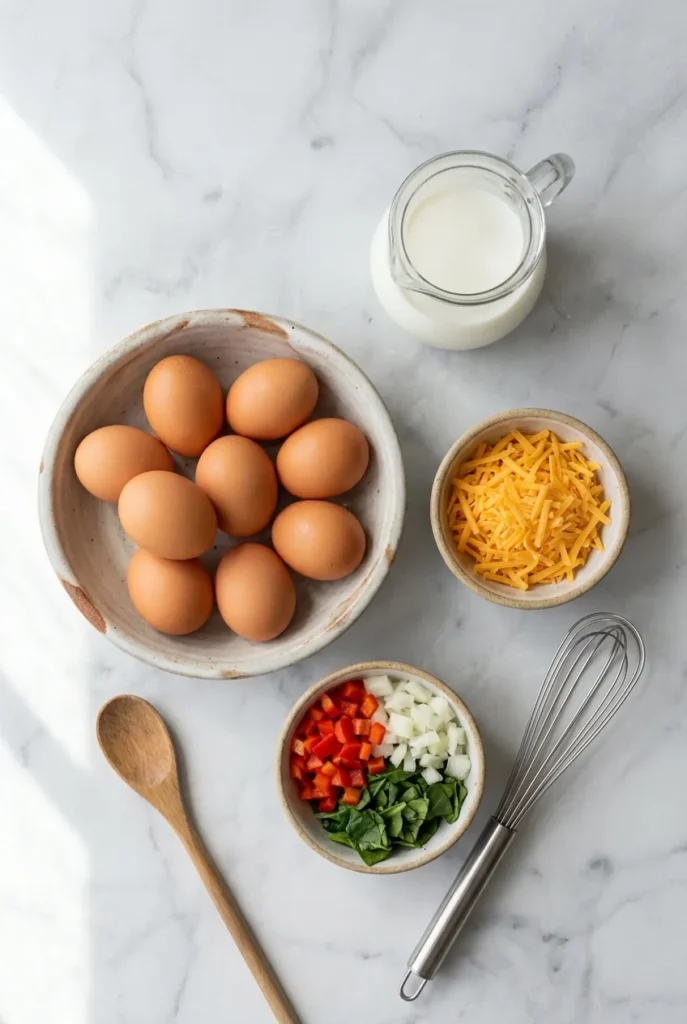
Six base ingredients. That’s it for the master recipe. Add-ins are where the variations come in, and we’ll get to those.
The Base (Makes 12 Muffin Cups)
- 8 large eggs. Room temperature whisks smoother and bakes more evenly. Pull them from the fridge twenty minutes before you start.
- 1/4 cup whole milk. Not heavy cream, not skim. Whole milk gives you tenderness without making them watery. Unsweetened almond milk works for dairy-free.
- 1/2 teaspoon kosher salt. I use Diamond Crystal. If you’re using Morton’s, cut to 1/3 teaspoon since it’s denser.
- 1/4 teaspoon black pepper, freshly cracked
- 1 cup shredded cheese, divided. Sharp cheddar is the default. Pre-shredded works fine here, the anti-caking starch actually helps the cups hold their shape.
- 1 cup add-ins, chopped small. See variations below.
Equipment That Actually Matters
- A standard 12-cup muffin tin. Nonstick metal or silicone. Silicone wins for release, metal wins for browning. I own both and reach for silicone 80% of the time when I’m meal prepping.
- A whisk. Not a fork. The fork leaves you with stringy whites and uneven texture.
- A liquid measuring cup with a spout, for pouring the egg mixture into the tin without a mess.
- A 3-cup glass meal prep container with a lid for storing the finished cups in the fridge.
No air fryer? You don’t need one. The standard oven method is what we’re using here, and it’s actually more reliable for a full batch of twelve.
How to Make Egg Muffin Cups, Step by Step
The whole process takes about thirty minutes start to finish, including bake time. Active work is under ten minutes.
Step 1: Preheat and Prep the Tin
Heat your oven to 350°F. Not 375°F. The lower temperature is the single biggest reason these cups stay fluffy instead of turning into rubbery hockey pucks. Grease your muffin tin generously with cooking spray, or use silicone liners. If you’re using a metal tin without liners, hit every cup including the top rim, since the eggs will climb a little.
Why it works: Eggs are mostly water and protein. At high heat, the proteins seize fast and squeeze out water, which is what creates the dry, rubbery texture nobody wants. At 350°F, they set gently and stay tender.
Step 2: Whisk the Eggs and Milk
Crack all 8 eggs into a large bowl. Add the milk, salt, and pepper. Whisk for about 30 seconds, until the mixture is uniformly yellow with no streaks of egg white. Don’t go beast mode on the whisking. Overbeaten eggs incorporate too much air, which puffs up in the oven and then collapses dramatically once they cool. You want even, not aerated.
What success looks like: A smooth, pale yellow liquid with just a few small bubbles on the surface.
Step 3: Layer the Add-ins
Divide your 1 cup of add-ins evenly across the 12 cups, about a packed tablespoon each. Then sprinkle half of the shredded cheese (1/2 cup) over the add-ins. Saving the other half of the cheese for the top is what gives you that golden, slightly crispy crown.
Why it works: Heavier ingredients go in first so they don’t all float to the top. Cheese on the bottom melts into the eggs and creates pockets of flavor; cheese on top browns and seals in moisture.
Step 4: Pour the Egg Mixture
Pour the egg mixture from your measuring cup into each muffin cup, filling each one about 3/4 full. This is critical. Fill them too high and they’ll overflow and look like little fried egg flying saucers. Fill them too low and they shrink dramatically. Three-quarters is the sweet spot.
Step 5: Top with the Rest of the Cheese
Sprinkle the remaining 1/2 cup of shredded cheese evenly across the tops. About a teaspoon per cup.
Step 6: Bake
Bake at 350°F for 18 to 22 minutes. Start checking at 18. They’re done when the centers are just set, not jiggly, and the tops are lightly golden. Internal temp should hit 160°F if you’re checking with an instant-read thermometer (the FDA-recommended safe temp for eggs).
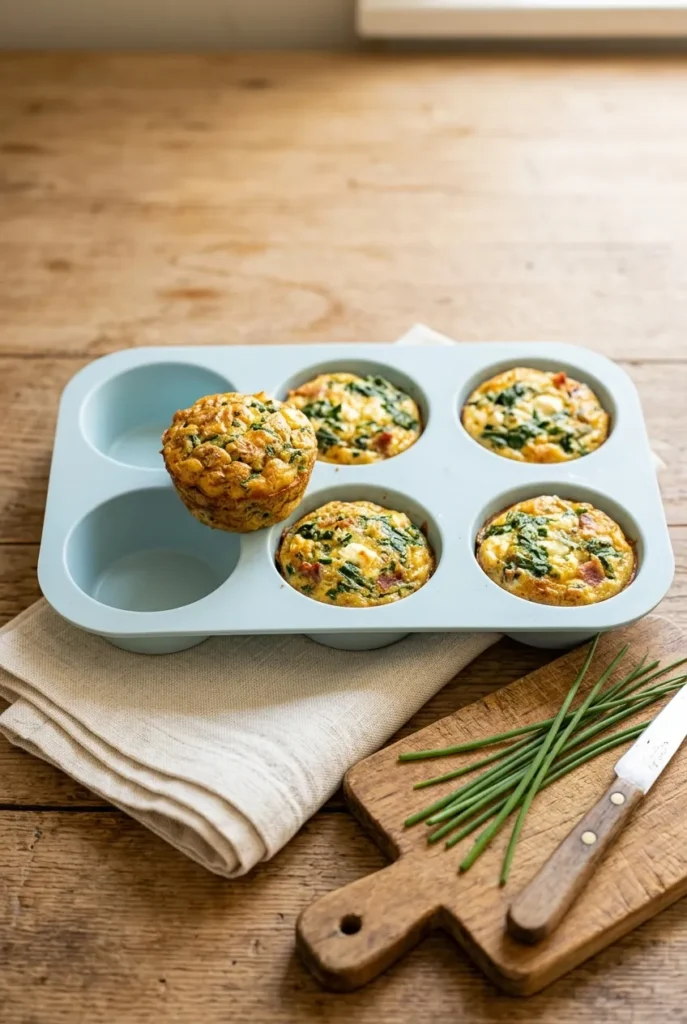
What success looks like: The tops are puffed slightly, the edges are pulling away from the sides of the cups, and a toothpick inserted in the center comes out clean with no wet egg.
Step 7: Cool Before Removing
This is the step everyone skips and then complains about ripped cups. Let them sit in the tin for 5 full minutes before you try to lift them out. The eggs continue to set as they cool and they release cleanly from the tin once they’ve had a chance to firm up.

The 4-Variable Egg Muffin Formula
This is the screenshot-worthy part. Once you nail the base, you can build any flavor combo you want using these four slots. Mix and match until your fridge gets bored.
| Slot | What Goes Here | How Much (for 12 cups) | Examples |
|---|---|---|---|
| Base | Eggs (+ optional dairy or cottage cheese for protein boost) | 8 eggs + 1/4 cup whole milk OR 1/2 cup cottage cheese | Standard, high-protein |
| Protein add-in | Cooked meat, beans, or tofu | 3/4 cup, chopped small | Cooked bacon, diced ham, crumbled sausage, black beans |
| Veggie add-in | Cooked or frozen-thawed and squeezed dry | 3/4 to 1 cup chopped | Spinach, bell pepper, zucchini, mushroom, tomato |
| Cheese | Shredded or crumbled | 1 cup total | Sharp cheddar, feta, pepper jack, Gruyère, goat cheese |
Save this table. It’s the whole game.
Three Variations That Actually Work
I’ve tested every one of these at least three times. These are the ones that landed.
Variation 1: Bacon and Cheddar (the Crowd-Pleaser)
- 6 slices cooked bacon, crumbled
- 1/2 cup diced bell pepper
- 1 cup shredded sharp cheddar
- Pinch of smoked paprika in the egg mixture
Cost tier: Mid-range at Trader Joe’s or Target, about $1.05 per cup Macros per cup: ~115 cal, 8g protein, 1g carbs, 8g fat
Variation 2: Spinach Feta (the Mediterranean Pull)
- 1 cup frozen chopped spinach, thawed and squeezed bone-dry
- 1/4 cup diced red onion
- 1 cup crumbled feta
- 1 teaspoon dried oregano in the eggs
Cost tier: Budget at Aldi, about $0.65 per cup Macros per cup: ~85 cal, 7g protein, 1g carbs, 6g fat
The spinach water step is non-negotiable. Wet spinach equals soggy bottoms. Squeeze it in a clean kitchen towel until you’ve wrung out at least 1/3 cup of water.
Variation 3: Ham and Swiss (the Lunchbox Classic)
- 3/4 cup diced deli ham (Black Forest or Applegate)
- 1/2 cup diced steamed broccoli
- 1 cup shredded Swiss or Gruyère
- 1/4 teaspoon Dijon mustard whisked into the eggs
Cost tier: Mid-range at Kroger or Target, about $1.15 per cup Macros per cup: ~105 cal, 8g protein, 1g carbs, 7g fat

The Cottage Cheese Upgrade (Borrow This for Any Variation)
Want serious protein? Swap the 1/4 cup of milk for 1/2 cup of small-curd cottage cheese, whisked in. This pushes each cup to 10 to 11g of protein without changing the cook time or texture in any meaningful way. The cottage cheese melts into the eggs and disappears completely. I promise no one will know.
Cost Per Serving by Store Tier
Most recipe blogs hand-wave about “cheap and healthy.” Here’s the actual math, run on a recent receipt for the base recipe plus the spinach feta variation.
| Store Tier | Where | Per Cup | What Drives the Price |
|---|---|---|---|
| Budget | Aldi, Walmart, Costco bulk | $0.55 to $0.75 | Store-brand eggs, frozen spinach, store-brand cheese |
| Mid-range | Trader Joe’s, Target, Kroger | $0.90 to $1.20 | Cage-free eggs, fresh produce, name-brand cheese |
| Splurge | Whole Foods, Sprouts, local | $1.50+ | Pasture-raised eggs, organic produce, imported feta |
For context, a McDonald’s Egg McMuffin runs around $4.50 in most US markets in 2026. Even the splurge tier of homemade beats that by two-thirds, with better macros and no mystery ingredients.
Weeknight Shortcut vs Sunday From-Scratch
If you’re prepping on a Sunday with time to spare, do the full method above. Cook your bacon, chop fresh veggies, shred your own cheese. Better flavor, better texture.
If it’s a chaotic Tuesday night and you’re prepping for tomorrow morning only, here’s the speed version:
- Skip the bacon. Use pre-cooked diced ham from the deli section or even leftover rotisserie chicken
- Skip the veggie chop. Frozen pepper-onion blend, microwave-thawed and patted dry, takes 90 seconds
- Skip the cheese shred. Pre-shredded works, period
- Cut the recipe in half. Six cups, one row of the tin, 16 to 18 minutes in the oven
Total time, weeknight version: under 20 minutes.
Storage and Reheating (Where Most Recipes Fail You)
Here’s the part competitors skim. I’ll be specific.
Storage
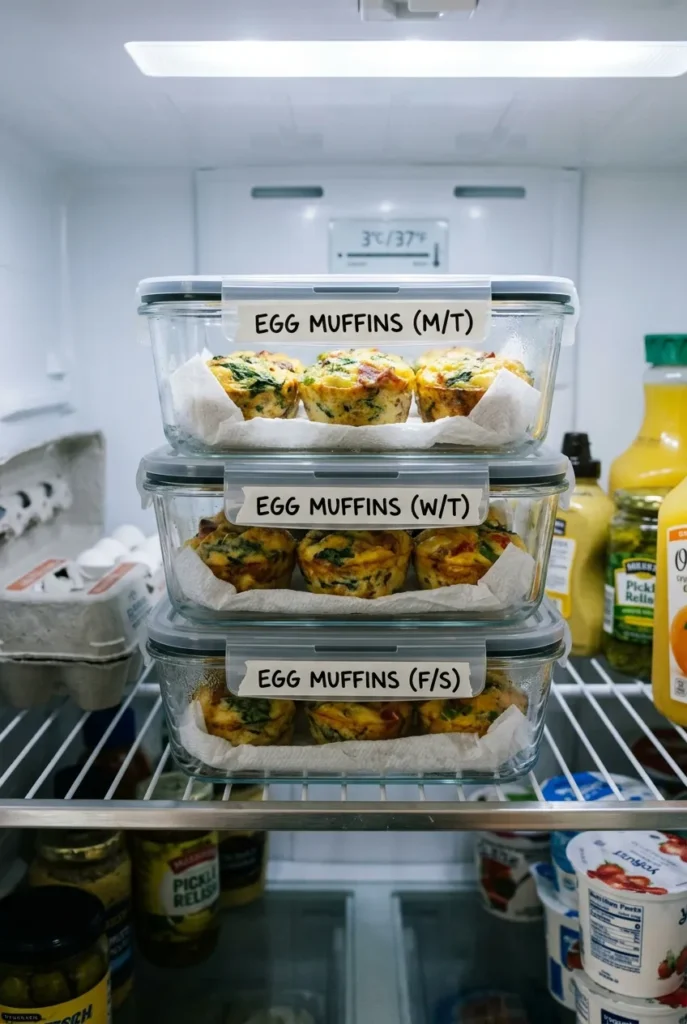
- Refrigerator: 4 days in an airtight container. Stack with a paper towel between layers to absorb condensation.
- Freezer: 3 months. Freeze in a single layer on a sheet pan for 1 hour first, then transfer to a freezer bag. This prevents them from fusing into a brick.
The FDA recommends consuming refrigerated cooked egg dishes within 3 to 4 days for safety, which matches what I’ve personally tested for texture.
Reheating Without the Rubber Texture
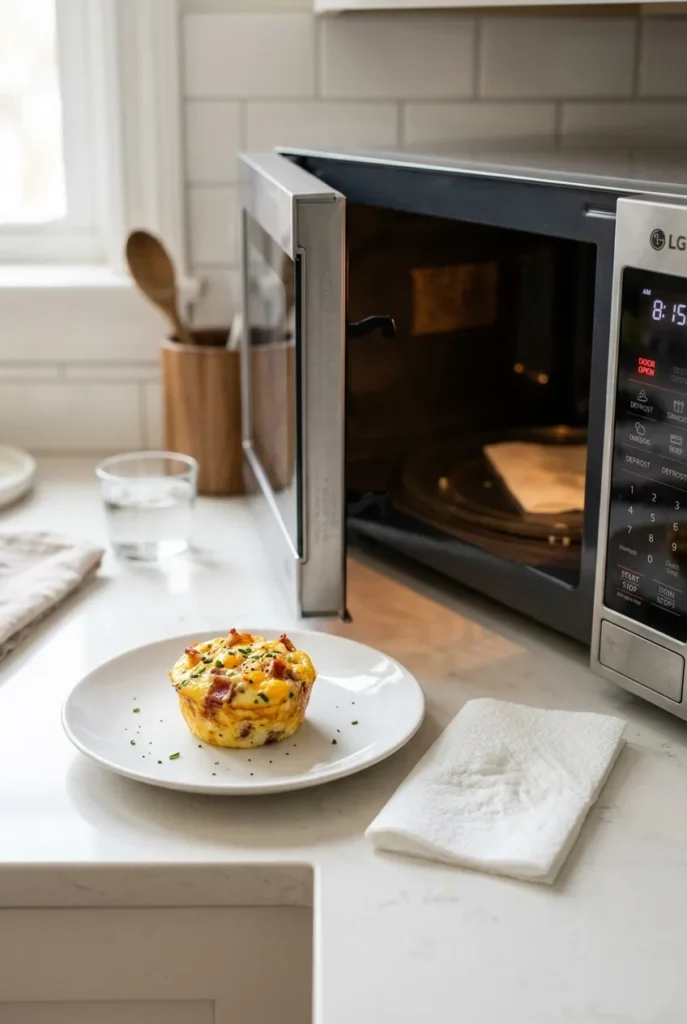
This is everything. The default microwave-on-high move is what makes egg muffin cups taste like sad gym food. Don’t do it. Try this instead.
From the fridge:
- Place 2 cups on a microwave-safe plate
- Cover loosely with a damp paper towel (this is the secret, the steam keeps them tender)
- Microwave at 50% power for 60 seconds
- Check, then add 15-second bursts if needed
From frozen:
- 1 cup on a plate, damp paper towel on top
- Microwave at 50% power for 90 seconds, then full power for 20 seconds
- Let rest 30 seconds before eating
Air fryer reheat (works great):
- 350°F for 3 minutes from the fridge
- 350°F for 5 minutes from frozen
- No paper towel needed, the air fryer keeps them dry and the edges crisp back up
Oven reheat (if you’re heating a bunch at once):
- 300°F for 8 to 10 minutes from the fridge
- Cover loosely with foil for the first 5 minutes
Dietary Swaps That Actually Hold Up
Real swaps, not just “use a substitute.” I’ve made each of these work.
- Dairy-free: Replace the milk with unsweetened almond milk or plain unsweetened soy milk. Skip the cheese or use a melty plant-based cheddar like Violife. Texture stays good.
- Gluten-free: The base recipe is already gluten-free. Just double-check your deli ham and bacon labels for hidden gluten in glazes.
- Vegetarian: Skip the meat add-in. Bump the veggie add-in to 1.5 cups and add 1/2 cup of black beans for protein.
- Whole30 / Paleo: Skip the cheese entirely and the milk. Add an extra egg to keep the volume right. Use compliant bacon (no sugar in the cure).
- Keto: The base recipe is already keto-friendly at under 2g net carbs per cup. The cottage cheese upgrade is also keto.
- For babies and toddlers: Skip the salt entirely until age one. Use mild cheese, soft veggies, and bake in a mini muffin tin (24 mini cups, 12 to 14 minutes at 350°F).
Scaling: Want More? Want Less?
The base recipe makes 12 cups. To scale:
- For 6 cups (single person or test batch): Halve everything. 4 eggs, 2 tablespoons milk, 1/2 cup add-ins, 1/2 cup cheese. Bake 16 to 18 minutes.
- For 18 cups: Use 12 eggs, 1/3 cup milk, 1.5 cups add-ins, 1.5 cups cheese. You’ll need 1.5 muffin tins or bake in two batches. Don’t scale the salt linearly; use 3/4 teaspoon, not a full teaspoon.
- For 24 cups (family of 4 or 5): Double the recipe but cut the salt to 3/4 teaspoon total, not a full teaspoon. Bake in two tins on two oven racks, rotating halfway through.
Salt, spice, and any aromatics like garlic powder don’t scale linearly. Always start with 75% of the scaled-up amount and adjust by taste.
Common Mistakes That Wreck Egg Muffin Cups
After making these way too many times, here are the missteps I see most often.
1. Oven too hot. 375°F is too aggressive. Stick to 350°F.
2. Overbeaten eggs. A 30-second whisk, not a 2-minute one. Too much air equals dramatic deflation as they cool.
3. Wet veggies. Frozen spinach, mushrooms, tomatoes, and zucchini all release water. Squeeze them dry in a clean kitchen towel before they go in the cups. Wet veggies equal soggy bottoms and lakes of liquid in the tin.
4. Filling cups too full. Three-quarters full, max. They puff in the oven.
5. Pulling them out of the tin too early. Five minute rest, every time. This is the difference between clean release and ripped bottoms.
6. Not greasing the rim of the tin. Eggs climb. Grease the tops, not just the cups.
7. Reheating on high power. 50% power, damp paper towel, every single time you reheat from the fridge.

What to Serve with Egg Muffin Cups
If you’re eating two cups, that’s a perfectly fine standalone breakfast at around 170 to 230 calories. To round out the meal:
- A piece of whole-grain toast with avocado for healthy fats and fiber
- A handful of berries or a small bowl of cut fruit
- A cup of plain Greek yogurt with a drizzle of honey
- Black coffee or a chai latte
- For a bigger pre-workout meal, add a small bowl of overnight oats on the side
You can also slice two cups, layer them into a tortilla with hot sauce, and have a breakfast wrap in under 90 seconds. Same prep, brand new meal. If you love this style of prep, check out our full system for healthy snack meal prep, which pairs beautifully with these for an all-day grab and go setup.

Pinterest Pin Card
If you’re saving this for Sunday, here’s the at-a-glance card.
Recipe: Egg Muffin Cups (Base + 3 Variations) Prep time: 10 minutes Cook time: 20 minutes Total time: 30 minutes Yield: 12 cups (6 servings of 2) Cost per cup: $0.55 to $1.50 depending on tier Macros per cup (base): 85 cal · 7g protein · 1g carb · 6g fat Storage: 4 days fridge, 3 months freezer Reheat: 50% power, damp paper towel, 60 seconds from fridge
Want to build a full meal prep day around these? Pair them with our sheet pan chicken and veggies for lunches, and add a few freezer meal prep dinners for the second half of the week. That’s Monday through Friday handled in one Sunday.
Egg Muffin Cup FAQ
How long do egg muffin cups last in the fridge?
About 4 days in an airtight container. If they smell off or feel slimy, toss them. The FDA guideline for cooked egg dishes is 3 to 4 days refrigerated. For longer storage, freeze them.
How long do egg muffin cups last in the freezer?
Up to 3 months in a sealed freezer bag. Freeze them in a single layer on a sheet pan first, for about an hour, before transferring to the bag so they don’t stick together.
Why do my egg muffin cups deflate and shrink?
Two reasons. First, oven temperature was too high, which caused the eggs to overpuff and then collapse as they cooled. Drop to 350°F. Second, you overbeat the eggs and incorporated too much air. Whisk for about 30 seconds, just until uniform yellow. A small amount of cooling shrinkage is normal. Dramatic deflation means one of those two things happened.
How do I reheat egg muffin cups without them going rubbery?
50% power on the microwave, damp paper towel on top, 60 seconds from the fridge. The damp towel creates steam, which keeps them tender instead of dry. Air fryer at 350°F for 3 minutes also works great and crisps the edges back up.
Can I make egg muffin cups in an air fryer?
Yes, with the right setup. Use silicone muffin liners or oven-safe ramekins that fit in your basket. Bake at 300°F for 12 to 15 minutes, checking at 12. Most baskets only fit 4 to 6 at a time, so air fryer is better for small batches than full meal prep.
Can I use cottage cheese in egg muffin cups?
Absolutely, and it’s the easiest protein boost going. Swap the 1/4 cup of milk for 1/2 cup of small-curd cottage cheese. Whisk it into the eggs and it’ll melt in completely. Each cup gains about 3g of protein, putting you at 10 to 11g per cup.
Can I make these dairy-free or vegetarian?
Both, easily. Dairy-free: swap the milk for unsweetened almond or soy milk and skip the cheese or use a plant-based melty cheese like Violife. Vegetarian: drop the meat, add 1/2 cup black beans plus extra veggies. The texture holds up well in both versions.
Can I double or halve this recipe?
Yes, but watch the salt. Doubling? Use 3/4 teaspoon salt, not a full teaspoon. Halving? Use 1/4 teaspoon, not 1/2. Aromatics and spices don’t scale in a strict 1:1 ratio because the perceived saltiness intensifies with volume.
Can I make egg muffin cups with hashbrowns?
Yes, and it’s a fan favorite. Press 1 to 2 tablespoons of thawed frozen shredded hashbrowns into each greased cup, pre-bake for 8 minutes at 400°F to get them crispy, then drop the heat to 350°F and pour the egg mixture on top. Total bake time goes up by about 5 to 7 minutes.
Why are my egg muffin cups watery on the bottom?
Wet veggies, almost always. Frozen spinach, mushrooms, tomatoes, and zucchini all release a surprising amount of water when they cook. Squeeze them in a clean towel before adding to the cups. You should be able to wring out 1/3 cup or more of water from a thawed package of frozen spinach.
The Wrap-Up
Egg muffin cups solve the breakfast problem in about thirty minutes of Sunday work. You get five mornings of high-protein, low-carb, genuinely tasty food for somewhere between $6.60 and $18 depending on where you shop, which is half what you’d spend grabbing a fast-food breakfast even one of those days.
Save this recipe to your Pinterest meal prep board, screenshot the 4-variable formula table, and try the spinach feta variation first. It’s the one I make most weeks. If you do, come back and leave a star rating, or tag your photos with #mealprepbix so I can see how yours turned out.
Which variation are you starting with this Sunday? Hit reply on the newsletter and let me know.