
Mediterranean Diet Meal Prep for Beginners: A Simple 5-Day Plan You’ll Actually Stick To
It’s 6 PM on a Tuesday. You stare into the fridge, see two limp scallions and a half-empty hummus tub, and the DoorDash app starts whispering your name. Sound familiar? That moment is exactly why Mediterranean diet meal prep exists, and once you have a system, that fridge tells a much better story.
This guide walks you through Mediterranean meal prep for beginners from a real Sunday workflow, not a Pinterest fantasy. You’ll get a 5-day plan, a printable-style grocery list, a five-component prep system that slots into six different bowls, macro callouts, cost per serving across three store tiers, and the exact containers I keep buying. I cook for two, my sister cooks for a family of five, and we both run this same system every week. It scales.
Who This Mediterranean Meal Prep Plan Is For
This plan was built with specific cooks in mind. If you’re one of these, you’ll feel right at home:
- Beginners who have heard “Mediterranean diet” a thousand times but never actually planned a week of it
- Busy professionals who need lunches that hold up from Monday to Friday at a desk
- Gym-goers tracking macros (protein hits 35-42g per bowl)
- Couples and singles prepping for one or two, with clean scaling notes for a family of four
- Budget cooks who shop at Aldi, Walmart, or Costco and want under $5 per serving
Not the right fit if you’re cooking for a household with seven different food preferences, or if you want fully separate meals for every day of the week. This plan uses a modular bowl system, which means the same five components rotate into different combinations.
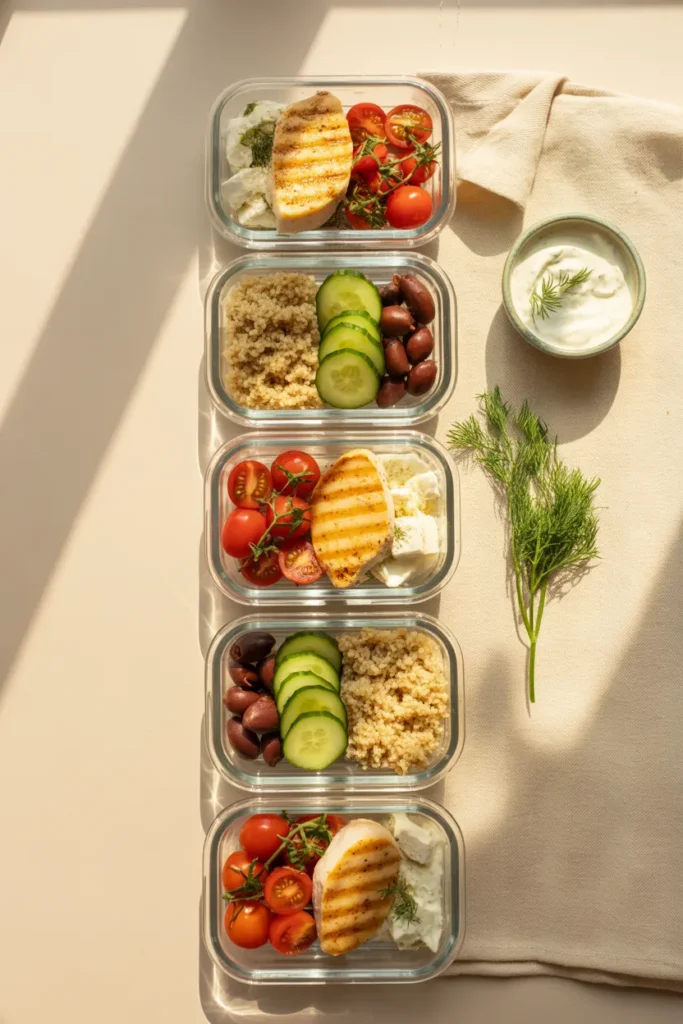
The 5-Component Mediterranean Prep System (the Whole Plan in One Table)
Here’s the framework that runs the entire week. Cook these five things on Sunday, then assemble different bowls Monday through Friday. Save this table or screenshot it.
| Component | What to Make | Yield (4 servings) | Sunday Prep Time |
|---|---|---|---|
| Protein | Lemon herb chicken thighs | 1.5 lb cooked | 25 min |
| Grain | Lemon-parsley quinoa | 4 cups cooked | 20 min (mostly hands-off) |
| Roasted veg | Sheet-pan zucchini, bell peppers, red onion | 6 cups | 25 min (hands-off) |
| Fresh veg | Cucumber, cherry tomatoes, kalamata olives | 4 cups combined | 10 min |
| Sauce | Lemon-garlic tahini drizzle | 1 cup | 5 min |
Total active time: about 90 minutes on Sunday. The oven and stove do most of the work while you wash containers and sip something.
What Mediterranean Diet Meal Prep Actually Means (Quick Beginner Primer)
If you’re brand new, here’s the short version. The Mediterranean diet is a plant-forward eating pattern built around vegetables, fruit, whole grains, legumes, nuts, fish and seafood a few times a week, moderate dairy (mostly yogurt and cheese), small amounts of poultry and eggs, very little red meat, and extra virgin olive oil as the main fat. Wine and water are the traditional drinks, and meals are typically slow and shared.
The research backing it is genuinely impressive. According to the Harvard T.H. Chan School of Public Health Nutrition Source, research supports the use of the Mediterranean diet as a healthy eating pattern for the prevention of cardiovascular diseases, increasing lifespan, and healthy aging. That’s why doctors keep recommending it. The Nutrition Source
For meal prep specifically, this is good news because the diet is structurally built for batching. Grains, legumes, roasted vegetables, and herb-forward sauces all hold beautifully for four to five days in the fridge.
Foods to Stock for Mediterranean Meal Prepping
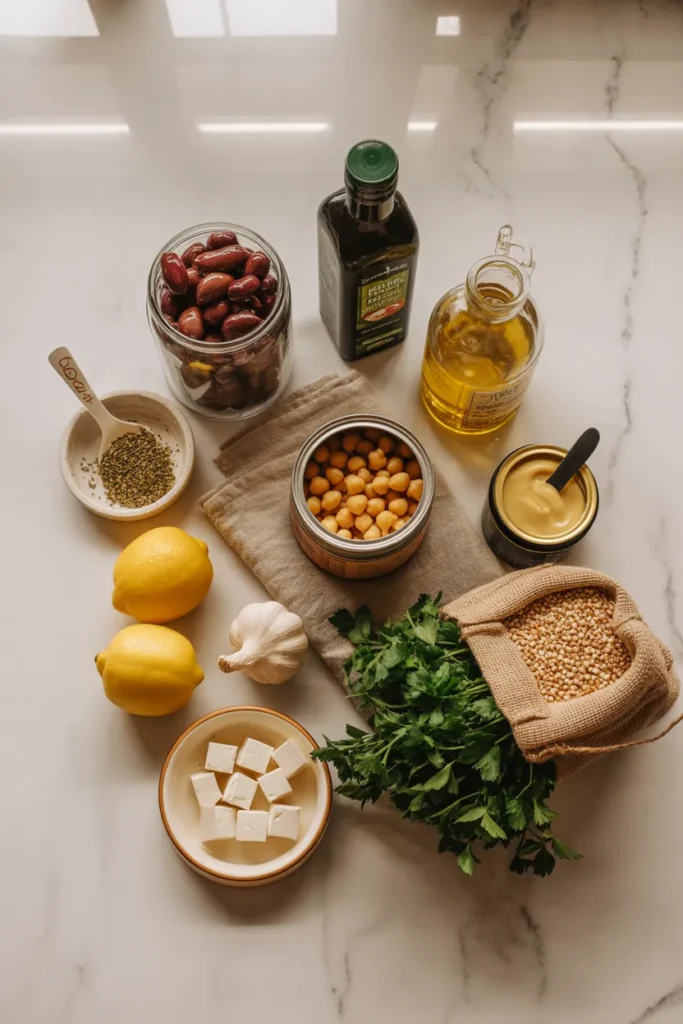
Before you cook a single thing, the pantry has to be right. Here’s what stays on rotation in my kitchen:
Pantry staples
- Extra virgin olive oil (a peppery, grassy bottle for finishing, plus a milder one for cooking)
- Canned chickpeas, white beans, and lentils
- Whole grains: quinoa, farro, bulgur, brown rice, whole-wheat orzo
- Canned wild-caught tuna and sardines packed in olive oil
- Kalamata olives, capers, sun-dried tomatoes
- Tahini, hummus, Dijon mustard, red wine vinegar, lemons
- Spices: dried oregano, smoked paprika, cumin, sumac, za’atar, garlic powder, flaky salt
Fridge staples
- Plain whole-milk Greek yogurt (Fage 5% is the gold standard)
- Feta in brine, Parmigiano Reggiano, fresh mozzarella
- Cucumbers, cherry tomatoes, baby spinach, arugula, fresh parsley, fresh dill
- Lemons (always more than you think)
- Eggs (more on the egg question in the FAQ)
Freezer staples
- Wild-caught salmon fillets
- Frozen shrimp, peeled and deveined
- Frozen artichoke hearts and chopped spinach
- Frozen edamame for fast bowls
If your pantry is bare, build it over two grocery trips. Don’t try to buy all of this in one cart unless you genuinely enjoy the pain.
Your 5-Day Mediterranean Meal Prep Plan (Breakfast, Lunch, Dinner, Snack)
Here’s the actual week. Macros are calculated per serving and rounded.
Day 1 (Monday)
- Breakfast: Greek yogurt parfait with berries, walnuts, and a drizzle of honey (380 cal, 22g protein, 38g carb, 14g fat)
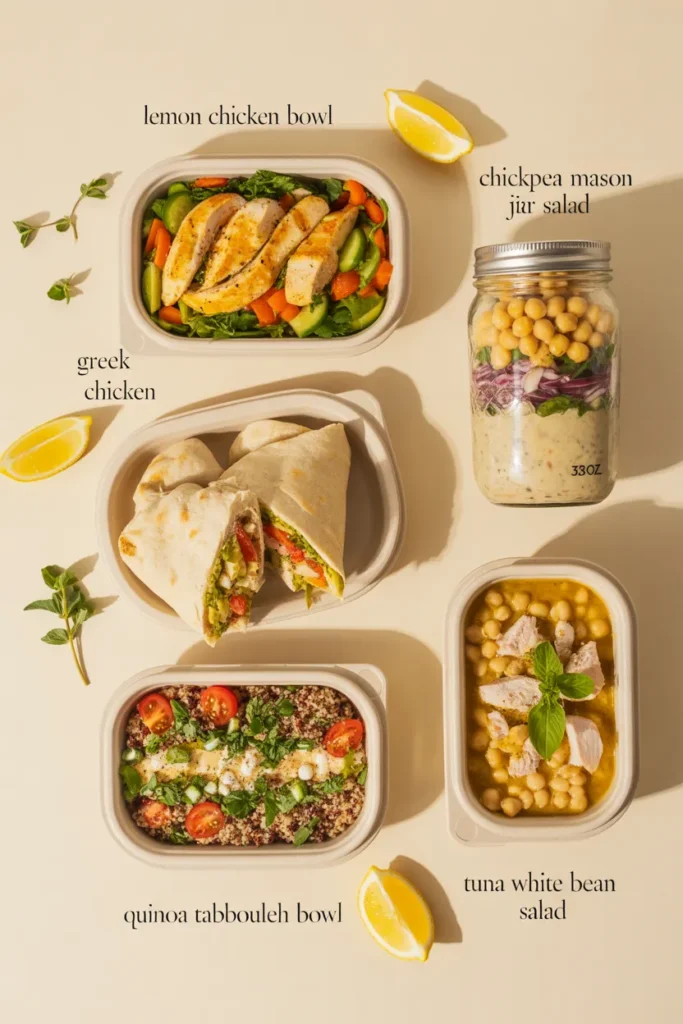
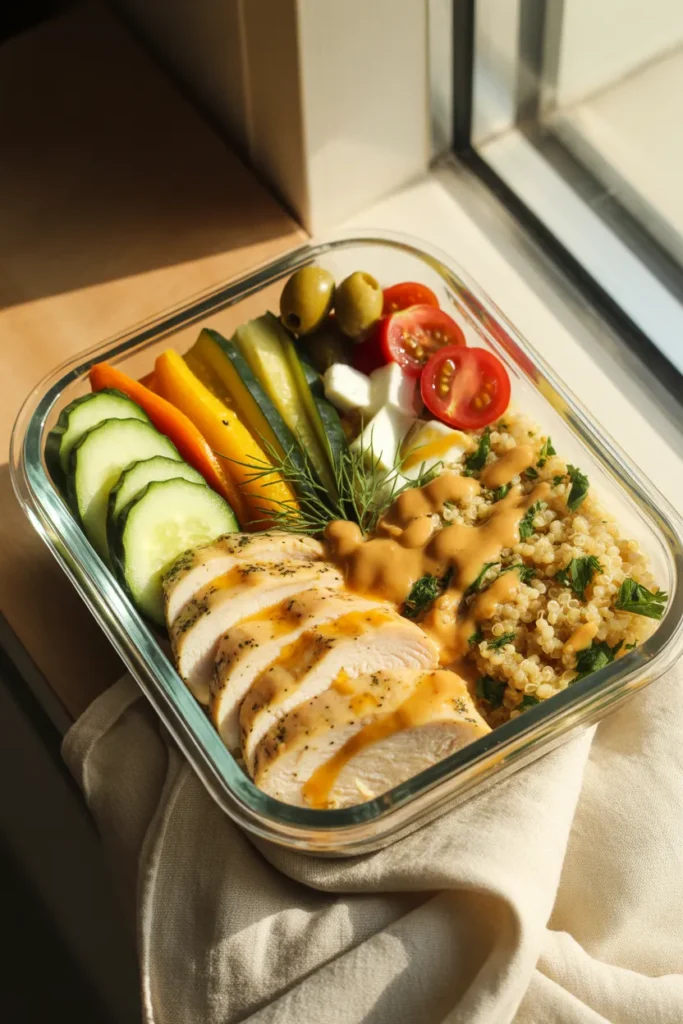
- Lunch: Lemon chicken Mediterranean bowl with quinoa, roasted veg, cucumber, tomato, olives, feta, tahini drizzle (540 cal, 38g protein, 48g carb, 22g fat)
- Snack: Apple slices with 2 tbsp almond butter (280 cal, 7g protein, 28g carb, 16g fat)
- Dinner: Sheet-pan salmon with roasted zucchini and farro (580 cal, 42g protein, 45g carb, 24g fat)
Day 2 (Tuesday)
- Breakfast: Veggie egg muffins (3) with whole-grain toast and avocado (420 cal, 24g protein, 32g carb, 22g fat)
- Lunch: Mediterranean chickpea mason jar salad (recipe below) (490 cal, 18g protein, 52g carb, 24g fat)
- Snack: Hummus with carrot and cucumber sticks (220 cal, 9g protein, 24g carb, 11g fat)
- Dinner: Same lemon chicken bowl as Monday lunch (yes, repeats are fine, that’s the point)
Day 3 (Wednesday)
- Breakfast: Overnight oats with chia, almond milk, and sliced banana (390 cal, 14g protein, 58g carb, 12g fat)
- Lunch: Greek chicken pita with tzatziki, cucumber, tomato, red onion (520 cal, 36g protein, 50g carb, 18g fat)
- Snack: Small handful of almonds and an orange (240 cal, 6g protein, 26g carb, 14g fat)
- Dinner: White bean and tomato skillet with crusty whole-grain bread (510 cal, 22g protein, 70g carb, 14g fat)
Day 4 (Thursday)
- Breakfast: Greek yogurt parfait, repeat from Monday
- Lunch: Quinoa tabbouleh bowl with roasted chickpeas and feta (530 cal, 22g protein, 62g carb, 22g fat)
- Snack: Whole-grain crackers with hummus and cherry tomatoes (260 cal, 8g protein, 32g carb, 12g fat)
- Dinner: Shrimp and orzo with spinach, lemon, and garlic (550 cal, 38g protein, 52g carb, 18g fat)
Day 5 (Friday)
- Breakfast: Veggie egg muffins, repeat from Tuesday
- Lunch: Tuna and white bean salad over arugula with olive oil and red wine vinegar (480 cal, 35g protein, 32g carb, 24g fat)
- Snack: Greek yogurt with honey (180 cal, 16g protein, 18g carb, 4g fat)
- Dinner: Mediterranean baked feta pasta with whole-grain penne and cherry tomatoes (580 cal, 22g protein, 78g carb, 22g fat)
Daily totals land between 1,700 and 1,900 calories with 100-130g protein, which is a solid sweet spot for most adults eating in a small deficit or at maintenance. Adjust portions based on your goals, height, and activity.
The Sunday Prep Workflow (90 Minutes, Step by Step)
This is the order that gets you out of the kitchen fastest. The trick is to start whatever takes longest first, then work the active stuff while it cooks.
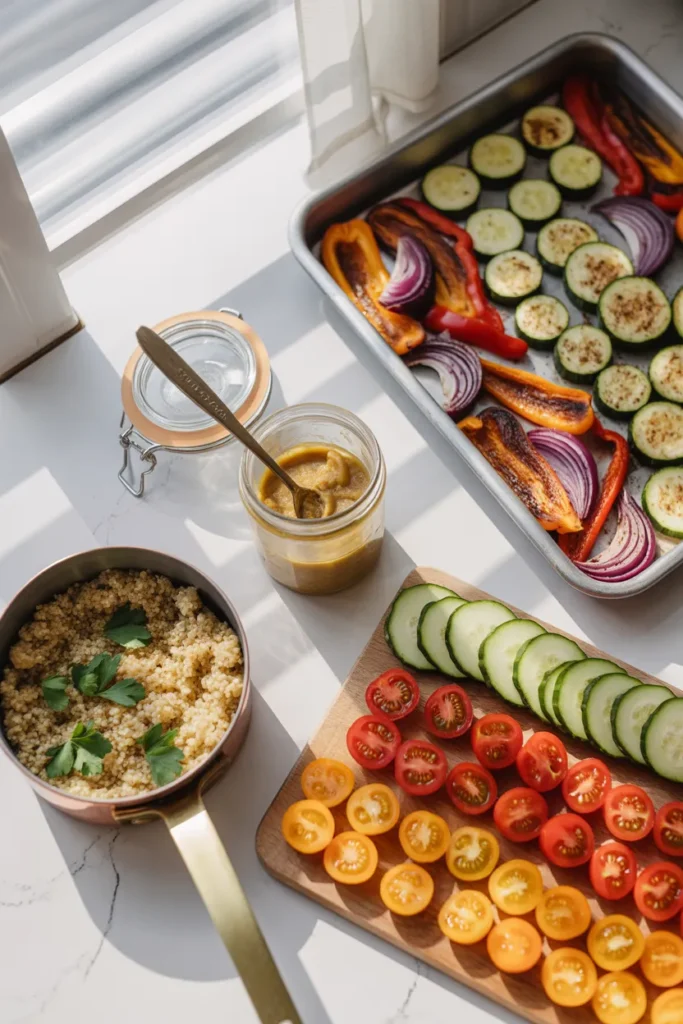
Step 1: Preheat the oven to 425°F (218°C) and start the quinoa. Rinse 1.5 cups dry quinoa in a fine mesh strainer until the water runs clear. This rinses off the saponins and is what makes the difference between fluffy and bitter. Combine with 3 cups water and a pinch of salt in a saucepan. Bring to a boil, cover, drop to the lowest simmer for 15 minutes. Success looks like: all the water absorbed, tiny tails uncurled from each grain.
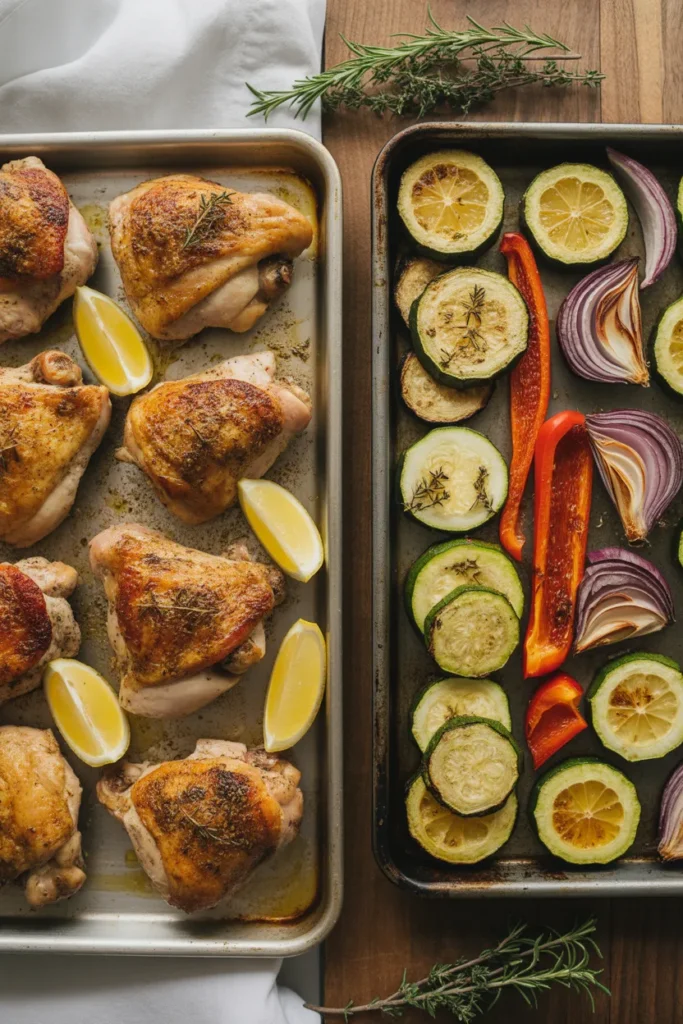
Step 2: While the quinoa cooks, prep the chicken. Pat 2 lb boneless skinless chicken thighs dry with paper towels. Drying is what gets you a sear instead of a steam. Toss in 3 tbsp olive oil, juice of 2 lemons, 4 minced garlic cloves, 2 tsp dried oregano, 1.5 tsp kosher salt, and a generous crack of black pepper. Spread on a sheet pan in a single layer.
Step 3: Prep the vegetable sheet pan. On a second sheet pan, toss 2 sliced zucchini, 2 sliced bell peppers, and 1 sliced red onion with 3 tbsp olive oil, 1 tsp salt, and a teaspoon of oregano. Spread in one layer (crowding equals steaming, and you want roasting).
Step 4: Both pans into the oven. Roast for 22-25 minutes. Chicken is done at an internal temperature of 165°F. Success looks like: chicken with golden caramelized edges and clear juices, vegetables charred at the corners with bright color holding through the middle.
Step 5: While the oven works, make the sauce. Whisk 1/2 cup tahini, juice of 1 lemon, 2 grated garlic cloves, 1/2 tsp salt, and 4-6 tbsp warm water until smooth. Success looks like: the sauce ribbons off the whisk, pourable but not watery. Adjust water a tablespoon at a time.
Step 6: Prep the fresh components. Slice 2 cucumbers, halve 2 cups of cherry tomatoes, drain 1 cup kalamata olives, crumble 6 oz feta. Store each in its own small container so nothing gets soggy.
Step 7: Cool, then assemble. Let the chicken and vegetables cool to room temperature within 2 hours, per USDA food safety guidelines which note that within 2 hours of cooking food or after it is removed from an appliance keeping it warm, leftovers must be refrigerated. Slice the chicken against the grain. Build your bowls or store components separately. I prefer separate, because you keep the textures right and you can build a different bowl every day. USDA FSIS
Cost Per Serving (Three Tiers, Real Numbers)
Mediterranean meal prep gets called “expensive,” and that’s only true if you shop at the wrong store. Here’s what one week (5 lunches plus 5 dinners, 10 servings total) costs me:
| Tier | Cost / Serving | Where to Shop |
|---|---|---|
| Budget | $4.20 | Aldi, Walmart, Costco for chicken thighs, bulk quinoa, store-brand olive oil, frozen shrimp, canned chickpeas |
| Mid-range | $5.60 | Trader Joe’s, Target, Kroger for chicken thighs, pre-washed greens, Trader Joe’s tahini, mid-tier feta |
| Splurge | $7.80 | Whole Foods, Sprouts for organic chicken, wild salmon, single-estate olive oil, imported feta in brine |
The biggest swing is the protein and the olive oil. A peppery, single-estate Italian olive oil at Whole Foods runs $22 a bottle, while a perfectly fine Aldi store-brand Greek olive oil is $7. Both work for meal prep. Save the splurge oil for finishing salads where you actually taste it.
Containers That Actually Work
After testing six brands, here’s what stays in my kitchen:
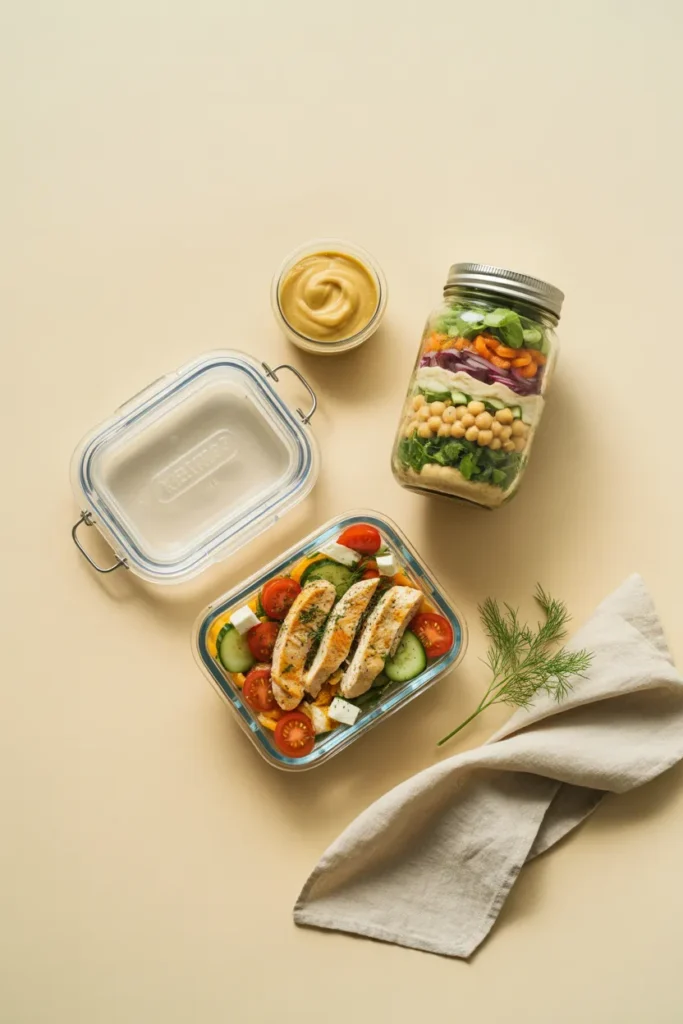
- Glass meal prep containers, 3-cup with locking lids for the main bowls. I use the OXO Smart Seal 3-cup glass set. Glass doesn’t stain from tomato or turmeric, microwaves cleanly, and holds shape in a backpack.
- 32 oz wide-mouth mason jars for layered salads. The wide mouth matters because you can fit a fork.
- Small 4 oz containers with screw-top lids for sauces and dressings (separate from the food until eating time, always).
- Reusable silicone bags for sliced fresh vegetables that you’ll grab as snacks.
Skip the cheap thin plastic containers from the grocery store endcap. They warp in the dishwasher within a month and hold odors forever.
Storage and Reheating: The Boring Stuff That Actually Saves Your Week
This is the section most blogs skip and the one that makes or breaks meal prep.
Refrigerator storage (in airtight containers at 40°F or below):
- Cooked chicken: 3-4 days. Per USDA Food Safety and Inspection Service, use most cooked leftovers within 3 to 4 days. Prep on Sunday, last bowl eaten by Wednesday or Thursday. Friday’s lunch should use a different protein (canned tuna, chickpeas, or a fresh-cooked egg). USDA FSIS
- Cooked quinoa or farro: 4-5 days
- Roasted vegetables: 4 days
- Tahini sauce: 5-7 days
- Cut cucumbers and tomatoes: 3 days (best fresh)
- Mason jar salads (assembled with dressing on the bottom): 4 days
Freezer storage:
- Cooked chicken: 2-3 months, sliced and portioned
- Cooked quinoa or farro: 2 months
- Roasted vegetables: not recommended (texture suffers badly)
- Soups and stews: 3 months
Reheating method matrix:
| Dish | Microwave | Stovetop | Air Fryer |
|---|---|---|---|
| Chicken bowl | 90 sec at 70% power, stir, 30 sec more | 3 min in a skillet with 1 tsp olive oil | 3 min at 350°F |
| Roasted vegetables | 60 sec at 70% power | 4 min in a hot dry skillet | 4 min at 375°F (best for crispness) |
| Quinoa | 45 sec at 70% with a splash of water | 2 min covered with 1 tbsp water | Skip |
| Salmon | Skip the microwave (rubbery) | 3 min covered, low heat | 4 min at 350°F |
The 70% power rule is the single best meal-prep tip nobody tells you. Full-blast microwave is what makes chicken rubber and rice cement. Lower power, more time, stir halfway.
Weeknight Shortcut vs Sunday From-Scratch
Not every week is a full Sunday cook. Here’s how to flex:
Sunday from-scratch (90 min, $4-6/serving): the full 5-component prep above. Maximum control, lowest cost.
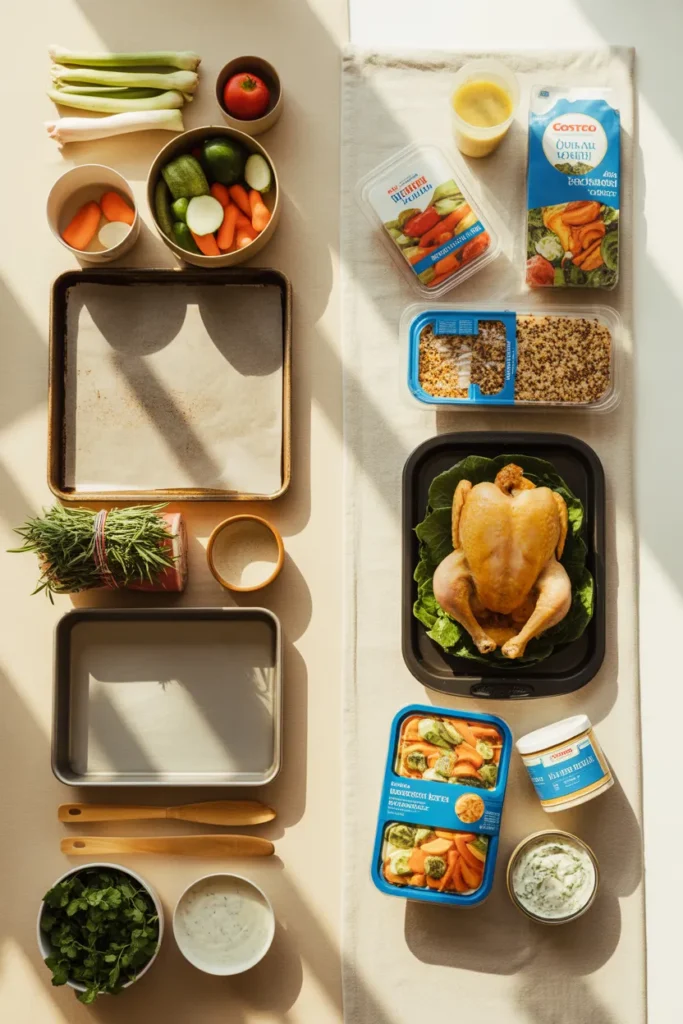
Weeknight 30-minute version ($7-9/serving): rotisserie chicken from Costco or your grocery store, microwave packets of pre-cooked quinoa from Trader Joe’s, pre-cut roasted vegetables from the prepared section, store-bought tzatziki, bagged greens, jarred kalamata olives, crumbled feta. Build bowls in real time. The convenience tax is roughly $3 per serving, and that’s a perfectly reasonable trade on a Wednesday in February when you got home at 7:15.
Mediterranean Recipe Card: Lemon Herb Chicken Mediterranean Meal Prep Bowls
The flagship recipe of the whole plan, in card format.
Description: High-protein, 30-minute lemon herb chicken Mediterranean bowls with quinoa, roasted vegetables, and lemon-tahini sauce. Holds 4 days in the fridge, $5.60 per serving at mid-tier stores.
- Prep time: 15 minutes
- Cook time: 25 minutes
- Total time: 40 minutes
- Servings: 4 meal prep bowls
- Calories per serving: 540 cal | 38g protein | 48g carb | 22g fat
Ingredients
For the chicken:
- 1.5 lb boneless skinless chicken thighs
- 3 tbsp extra virgin olive oil
- Juice of 2 lemons (about 1/4 cup)
- 4 garlic cloves, minced
- 2 tsp dried oregano
- 1.5 tsp kosher salt
- 1/2 tsp black pepper
For the quinoa:
- 1.5 cups dry quinoa, rinsed
- 3 cups water
- 1/2 tsp salt
- 1/4 cup chopped fresh parsley
- Juice of 1/2 lemon
For the vegetables:
- 2 medium zucchini, sliced into 1/2-inch rounds
- 2 bell peppers (red and yellow), sliced
- 1 red onion, sliced
- 3 tbsp olive oil
- 1 tsp salt
- 1 tsp dried oregano
For the bowls:
- 2 cucumbers, sliced
- 2 cups cherry tomatoes, halved
- 1 cup kalamata olives, drained
- 6 oz feta cheese, crumbled
For the lemon-tahini sauce:
- 1/2 cup tahini
- Juice of 1 lemon
- 2 garlic cloves, grated
- 4-6 tbsp warm water
- 1/2 tsp salt
Instructions
- Preheat oven to 425°F. Rinse quinoa in a fine mesh strainer until water runs clear.
- Combine quinoa, water, and salt in a saucepan. Bring to a boil, cover, reduce to lowest simmer, cook 15 minutes. Remove from heat, let steam 5 minutes, fluff with a fork. Stir in parsley and lemon juice.
- Pat chicken dry with paper towels. Toss with olive oil, lemon juice, garlic, oregano, salt, and pepper. Spread on a sheet pan in a single layer.
- On a second sheet pan, toss zucchini, peppers, and onion with olive oil, salt, and oregano. Spread in a single layer.
- Roast both pans for 22-25 minutes until chicken reaches 165°F internal temperature and vegetables are charred at the edges.
- While oven runs, whisk tahini sauce ingredients until smooth and pourable. Slice cucumbers, halve tomatoes, drain olives, crumble feta.
- Let chicken and vegetables cool, then slice chicken against the grain.
- Assemble bowls: 1 cup quinoa, 4 oz chicken, 1.5 cups roasted vegetables, 1/2 cup mixed cucumber and tomato, 2 tbsp olives, 1.5 oz feta, 2 tbsp tahini sauce on top or in a small separate container.
Notes
- Storage: 4 days in the fridge, 2 months in the freezer (sauce separately)
- Reheat: 90 sec microwave at 70% power, stir, 30 sec more
- To scale to 6 servings: multiply chicken, quinoa, and vegetables by 1.5. Sauce only needs 1.25x. Salt and oregano: 1.3x, not a full 1.5x (spices don’t scale linearly).
- Dairy-free swap: omit feta, double the olives and add 1/4 cup roasted red peppers
- Gluten-free: this recipe already is, just verify your tahini brand
- Container: 3-cup glass meal prep containers with locking lids
Equipment
- Two half-sheet pans (Nordic Ware aluminum, the rim helps catch juices)
- Fine mesh strainer (the difference between fluffy and bitter quinoa)
- 3-cup glass meal prep containers with locking lids (4 of them)
- 4 oz sauce containers with screw lids
Common Mediterranean Meal Prep Mistakes to Avoid
After running this system for over a year and answering hundreds of reader questions, these are the five mistakes I see again and again:
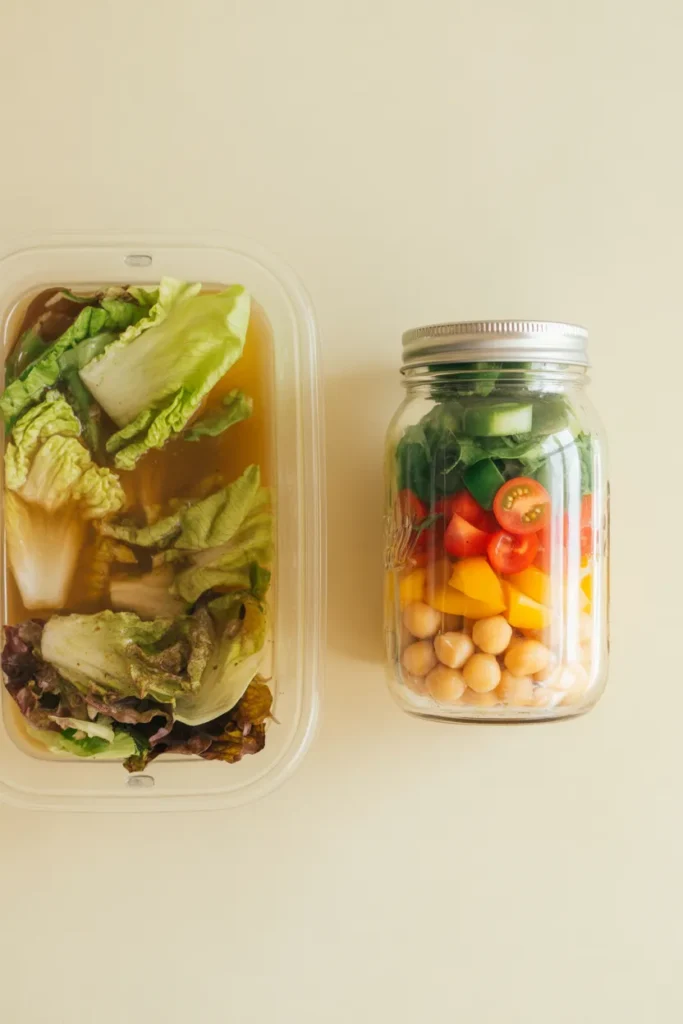
- Dressing the salad on Sunday. Mason jar salads work because the dressing sits at the bottom under hardy ingredients (chickpeas, peppers, onion) with greens at the top. Pre-dressing makes Wednesday’s lunch a sad puddle.
- Roasting vegetables on a crowded sheet pan. Two pans, single layer, every single time. A crowded pan steams instead of roasts and you lose all the caramelization.
- Cooking chicken breast for the whole week. Breast dries out by day 3. Boneless thighs hold moisture for 4 full days and they’re cheaper.
- Skipping the rinse on quinoa. The bitter saponin coating is the entire reason people think they don’t like quinoa. Rinse for 30 seconds, problem solved.
- Forgetting acid. Mediterranean food lives or dies on lemon, vinegar, and brine. A bowl that tastes flat usually needs another squeeze of lemon, not more salt.
Mediterranean Meal Prep Grocery List (Print This)
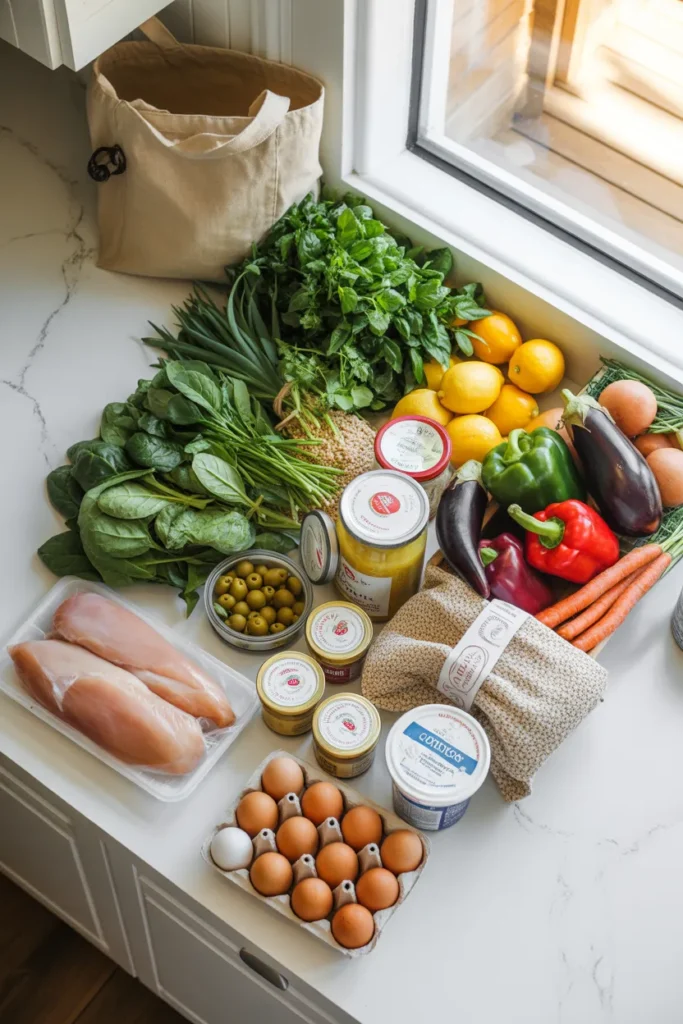
Built for 4 servings of each meal across 5 days for one person, or scale 4x for a family of four.
Produce
- 4 lemons
- 2 cucumbers
- 2 cups cherry tomatoes
- 2 zucchini
- 2 bell peppers
- 2 red onions
- 1 head garlic
- 1 bunch flat-leaf parsley
- 1 bunch fresh dill
- 5 oz baby spinach or arugula
- 3 apples
- 1 pint berries
- 1 banana
- 2 carrots
Protein
- 1.5 lb boneless skinless chicken thighs
- 1 lb salmon fillet
- 1 lb shrimp (frozen is fine)
- 1 can wild-caught tuna in olive oil
- 1 dozen eggs
Pantry / dry
- 1.5 cups dry quinoa
- 1 cup farro
- 1 box whole-grain orzo
- 2 cans chickpeas
- 1 can white beans
- 1 jar kalamata olives
- 6 oz feta in brine
- 1 small container Greek yogurt (32 oz)
- Extra virgin olive oil
- Tahini
- Red wine vinegar
Pantry staples (probably have already)
- Dried oregano, kosher salt, black pepper, garlic powder, smoked paprika, honey, almond butter, walnuts, almonds
If you want a reusable framework for your weekly trip, our printable grocery list weekly meal prep template builds out the whole system on one page.
Variations and Swaps to Keep It Interesting Past Week 4
The fastest way to burn out on meal prep is eating the same bowl for 12 weeks straight. Rotate the components:
- Swap the protein: baked salmon, shrimp, hard-boiled eggs, white beans, lentils
- Swap the grain: farro, bulgur, brown rice, whole-grain orzo, cauliflower rice
- Swap the roasted veg: broccoli, sweet potato, eggplant, cauliflower, asparagus
- Swap the sauce: tzatziki, lemon-dill yogurt, romesco, pesto, harissa-yogurt
- Swap the cuisine accent: lean Greek (oregano, lemon, feta), Italian (basil, sun-dried tomato, parm), Levantine (sumac, za’atar, tahini), Spanish (smoked paprika, sherry vinegar, manchego)
Same prep system, twenty-something different bowls. That’s how this stays sustainable.
If you’d rather build out an evening meal calendar that fits the same template, our easy dinner recipes for family post pulls the same Mediterranean components into family-style dinners.
A Note for Calorie-Conscious Preppers
If your goal is a moderate calorie deficit, this plan flexes. Drop the feta from a bowl and you save about 90 calories. Use 3 oz chicken instead of 4 oz and you save 50. Halve the tahini drizzle and you save 60. Small swaps add up to a 200-300 calorie cut without ever feeling deprived. For more ideas in that lane, see our low calorie meal prep under 500 calories post.
Frequently Asked Questions
What is the 7-day Mediterranean diet?
The 7-day Mediterranean diet is a one-week meal plan built on the core Mediterranean pattern: vegetables and fruit at every meal, whole grains and legumes daily, fish two to three times a week, moderate poultry and dairy, very little red meat, and extra virgin olive oil as the primary fat. Most plans (including this one) cover breakfast, lunch, snack, and dinner so you don’t have to think about it. The 5-day prep version above covers Monday through Friday and leaves the weekend flexible.
What is the 3-3-3 rule diet?
The 3-3-3 rule is a simplified eating framework that suggests three balanced meals per day, three hours of spacing between them, and three core components per meal (protein, carb, vegetable or fruit). It’s not officially Mediterranean, but it pairs well with this plan because Mediterranean bowls already hit all three components by design.
Is Mediterranean meal prep good for weight loss?
Yes, when paired with a moderate calorie deficit. The Mediterranean pattern is high in fiber, protein, and healthy fats, which keep you full longer and reduce snacking. The Harvard Chan School notes that the Mediterranean diet may be especially helpful for keeping weight off over time. The meal prep version helps because it eliminates the “what’s for dinner” decision fatigue that drives takeout. Harvard Health
How many eggs per week on a Mediterranean diet?
Most Mediterranean diet pyramids recommend up to 4 eggs per week as a general guideline, though current research increasingly supports moderate egg consumption (one a day) for most healthy adults. If you have specific cholesterol concerns, check with your doctor. The plan above uses 6 eggs across the week (in the muffins).
What is not allowed on a Mediterranean diet?
Nothing is strictly forbidden, but ultra-processed foods, sugary drinks, refined grains (white bread, white pasta, sugary cereal), processed meats (bacon, deli meats, hot dogs), and frequent red meat are all minimized. The diet focuses on what to eat more of rather than what to cut out.
Are bananas okay on the Mediterranean diet?
Yes. Bananas are a whole fruit and fully fit the pattern. Pair them with Greek yogurt, oats, or a tablespoon of nut butter to slow the carb release and add protein.
How long does Mediterranean meal prep last in the fridge and freezer?
Cooked chicken, fish, and grains last 3-4 days in the fridge per USDA guidelines. Roasted vegetables hold 4 days. Tahini and yogurt-based sauces last 5-7 days. For freezer storage, cooked chicken and grains hold 2-3 months. Roasted vegetables don’t freeze well (texture suffers).
Can I make this dairy-free or gluten-free?
Yes to both. For dairy-free, drop the feta and Greek yogurt; double up on olives, hummus, and tahini for richness; swap yogurt parfaits for chia pudding made with coconut milk. For gluten-free, swap orzo and pita for quinoa or rice-based alternatives, and verify your oats are certified gluten-free.
Can I double or halve this recipe?
Doubling works cleanly across all components: chicken, quinoa, and roasted vegetables scale linearly. Sauce only needs 1.5x for a 2x recipe (you always over-make sauce relative to the food). Salt and dried herbs scale at about 1.3x for a 1.5x batch and 1.7x for a 2x batch (spices don’t scale linearly because of palate adaptation). For halving, cut everything in half except oregano, which you’ll want to leave at 75% of the original.
Save This for Sunday Prep
If you’ve made it this far, you have everything you need to run a full Mediterranean meal prep week starting tomorrow. The recipe card is built to screenshot, the grocery list is built to print, and the 5-component system is the part that stays with you long after you forget the specific bowls.
Save this post to your meal prep Pinterest board, then come back next week and tell me which bowl combination you ran. The shrimp orzo is my personal favorite, but the lemon chicken bowl is the one that converts skeptics. If you give it a star rating in the recipe card below, it helps other beginners find this plan too.